Ensuring Resilient IoT Connectivity: The Role of a Local IoT Agent
This article highlights the critical role of a local IoT agent in maintaining persistent cloud connectivity for IoT devices. It underscores the agent’s importance in detecting disconnections and automating reconnection across WiFi, Ethernet, and 4G networks. For WiFi and Ethernet, the agent focuses on tracking link status and re-establishing cloud connections. For 4G, it manages modem states, provider-specific settings, and session recovery. Architecturally, the agent can be monolithic (ideal for MCUs) or standalone (suited for CPUs with more resources). The monolithic approach simplifies deployment, while the standalone design offers flexibility and advanced features. By understanding these scenarios and architectural considerations, developers can create resilient IoT solutions. For further assistance, Nestedbytes provides expertise in embedded systems and IoT connectivity.
Ensuring Resilient IoT Connectivity: The Role of a Local IoT Agent
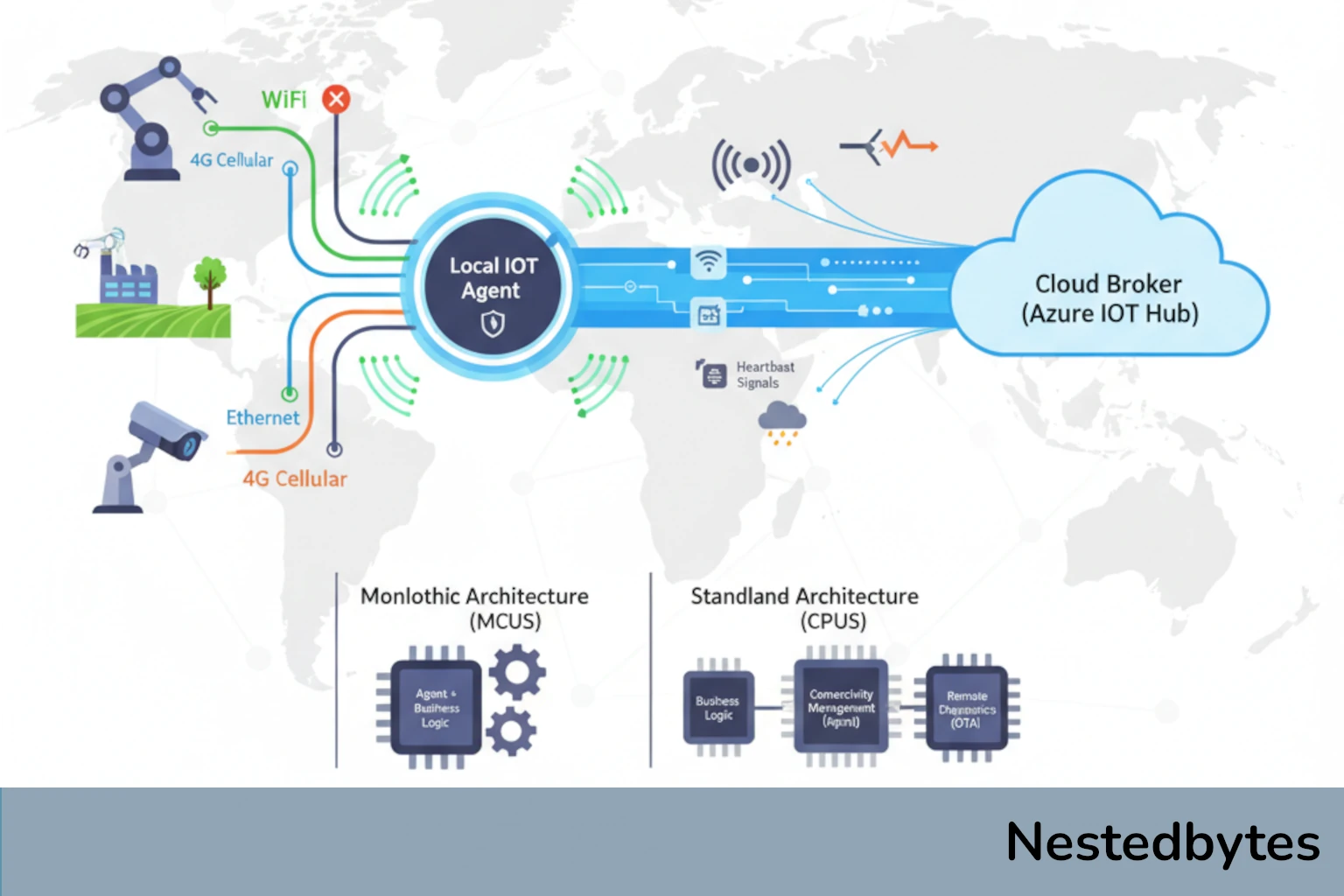
In the IoT ecosystem, devices must maintain persistent, reliable connections to cloud brokers like Azure IoT Hub. However, network instability, hardware issues, or environmental factors can disrupt these connections. A local IoT agent is essential to detect disconnections, diagnose root causes, and automate reconnection. This article explores the importance of such agents, connectivity scenarios, and architectural considerations for robust IoT deployments.
Importance of Device IoT Agent
IoT devices—especially those always powered and connected via 4G, WiFi, or Ethernet—require continuous communication with cloud platforms. A local IoT agent ensures this by monitoring the connection status and initiating reconnection procedures. Without such an agent, devices risk prolonged downtime, data loss, and operational failures. For instance, in industrial monitoring, a disconnected sensor may miss critical data transmissions. The agent acts as a safeguard, autonomously restoring connectivity and minimizing manual intervention. It also handles authentication, session management, and error recovery, making it a cornerstone of reliable IoT deployments.
Connectivity Type Scenarios
WiFi and Ethernet
For WiFi and Ethernet, the network layer typically manages reconnection automatically. The IoT agent’s role is to:
- Monitor link status and detect disconnections.
- Re-establish the cloud connection once the physical or logical link is restored.
- Handle edge cases, such as DHCP lease renewals or IP conflicts, to ensure seamless reconnection.
4G Connectivity
4G introduces additional complexity due to its reliance on cellular networks and SIM-based authentication. The agent must:
- Manage the modem and SIM state, including PIN unlocking, network registration, and signal strength monitoring.
- Handle provider-specific configurations, such as APN settings, which may require fine-tuning for different carriers.
- Reconnect to the cloud broker after the 4G link is re-established, often involving MQTT or AMQP session recovery.
- Implement fallback mechanisms, such as switching between primary and secondary APNs, to improve resilience.
The agent’s ability to adapt to varying network conditions and provider requirements is critical for maintaining uptime in cellular IoT deployments.
IoT Agent Architecture
The architecture of the IoT agent depends on the device’s resources and operating system:
Monolithic Architecture (MCUs)
On resource-constrained microcontrollers, the agent is typically integrated with the business logic. This monolithic approach:
- Reduces overhead by combining connectivity management and application logic in a single binary.
- Simplifies deployment but may limit flexibility for updates or debugging.
Standalone Architecture (CPUs)
For more powerful CPUs running Linux or RTOS, the agent can be a separate process or service. This modular design:
- Decouples connectivity management from business logic, allowing independent updates and scaling.
- Supports advanced features, such as logging, remote diagnostics, and over-the-air (OTA) updates.
- Enhances fault isolation, as a crash in the business logic does not affect the agent’s ability to reconnect.
The choice of architecture impacts development complexity, maintainability, and the agent’s ability to handle complex scenarios.
Conclusion
A local IoT agent is indispensable for maintaining robust cloud connectivity in IoT devices. By addressing the unique challenges of WiFi, Ethernet, and 4G networks, and by adapting to the device’s resources, the agent ensures reliable operation and minimal downtime. For expert guidance on implementing such solutions, consider reaching out to Nestedbytes, a specialist in embedded systems and IoT connectivity.